INHALTSVERZEICHNIS
- Background
- Midterms - The Senate
- Midterms - The House of Representatives
- Results and Times
- Runoffs
- Sources
- The Widgets in Detail ...
- 2026 Midterms (Senate): Republican and Democratic candidates
- Parties
- API
- Contact
Background
The US Congress consists of two chambers, the Senate and the House of Representatives. At the midterms, eligible voters cast ballots every two years on roughly one third of Senate seats as well as all seats in the House of Representatives.
Congress is involved in legislation and is meant to serve as a check on the president. Both chambers of Congress are based at the Capitol in Washington, D.C.
Although US President Donald Trump is not himself on the ballot, the outcome of these midterm elections - which are being watched with great anticipation around the world - will have a major impact on his second term. Both chambers of Congress are currently dominated by Trump's Republicans. Should the balance of power shift as a result of the midterms, the Democratic Party could block government initiatives that require congressional approval. A renewed attempt at impeachment proceedings against the president would also be conceivable.
Ahead of the vote, both parties attempted to influence the outcome through legal changes. These included, among other things, the redrawing of electoral districts and requirements for voter registration.
The 120th United States Congress will convene on January 3, 2027.
Midterms - The Senate
In the Senate , each state is represented by two senators. The 100 senators, each serving six-year terms, are divided into three classes. These three classes are elected on a rotating basis every two years. The seats are distributed in such a way that both Senate seats of any given state are never up for election at the same time.
In 2026, Class II, comprising 33 senators, is up for re-election. In addition, there are two special elections in Florida and Ohio, as a senator from each of those states vacated their seat early to take up a position in the US government.
As of July 1, 2026, the Republicans hold 53 of the 100 Senate seats, meaning the Democrats (47) would need to gain a net four seats for a potential change of control. The Democratic caucus includes 45 senators, though independents Bernie Sanders (Vermont) and Angus King (Maine) vote with them.
In Senate votes, a simple majority of 51 seats is sufficient. In the event of a tie (50:50), the deciding vote falls to the US vice president, who also presides over the Senate. That is currently Republican J.D. Vance.
Midterms - The House of Representatives
The House of Representatives has 435 members, all of whom are elected every two years by direct vote in their respective districts. Electoral districts are constituencies defined by individual states, intended to contain roughly similar numbers of eligible voters. This ensures that each state is represented in the House in proportion to its total population.
Particular attention ahead of the midterms has been paid to controversial efforts by several states to redraw the boundaries of individual electoral districts. The aim of this practice - known as "gerrymandering" - is to improve a party's chances of winning by shifting district boundaries in line with the local population make-up.
Gerrymandering plays no role in US Senate elections, where each state constitutes a single constituency.
As of September 16, 2026, ahead of the November 3 election, the balance of power in the House of Representatives stands at 218 Republicans to 214 Democrats. One Member is independent, two of the 435 seats are currently vacant.
Results and Times
Before the election, our widgets display polling results (exception: the map widgets will remain blank until live data begins to come in). Results from the primaries used to determine candidates will not be published. Approximately 15 minutes before the first results are published, the polling figures will be replaced by the notice "No data available yet." For this purpose, the result type in the settings on the setup page is set to "auto." Note: In the settings, the result type can be switched from "auto" to "live" or "poll." "Live" displays only live results and no polls; if "poll" is selected, no live results are incorporated and the widget will permanently display the current polling figures.
The elections covered are those for both congressional chambers - the Senate and the House. The concurrent gubernatorial elections do not form part of the congressional elections and are not covered by us.
The first individual trend results are expected on the night of Tuesday, November 3, into Wednesday, November 4, after the first polling stations on the US East Coast close at around 1:00 a.m. CET.
As polling stations in the Midwest close from around 3:00 a.m. CET, a nationwide trend should become apparent.
From 5:00 a.m. CET, polling stations on the US West Coast (including California) will close, with Alaska bringing up the rear at 7:00 a.m. CET.
IMPORTANT: In the event of very close results, the counting of postal votes may cause delays in determining the outcome. Particularly in the House of Representatives race, the large number of electoral districts means this process can take days or weeks.
Once the total of 100 seats in the Senate (House of Representatives: 435) has been reached - i.e. Republican wins plus Republican holdovers, plus Democratic wins plus Democratic holdovers - the result type switches from "interim result" (trend) to "final result" (preliminary).
IMPORTANT: Should a runoff election become necessary in any state, the overall result will remain an "interim result."
Runoffs
In the majority of US states, candidates need only a simple majority to win. Exceptions to this rule are:
- Georgia: If no candidate receives more than 50% of the vote in Georgia on November 3, a runoff will be held between the two leading candidates.
- Louisiana: If no candidate reaches an absolute majority in Louisiana, a runoff between the two leading candidates will be held in December.
Sources
Polls
As the basis for our polls ahead of election day on November 3, we use two sources:
RealClearPolitics (https://www.realclearpolitics.com/, https://www.realclearpolling.com/)
270toWin (https://www.270towin.com)
The source for the poll displayed in each widget is shown in the upper left. Clicking the arrow opens a menu showing the poll from the alternative source. This menu always shows only the most recent poll from the respective source.
Results
The source of results data for both congressional chambers is the US news agency Associated Press (AP).
The Widgets in Detail ...
Senate Module - Overall Result Bar
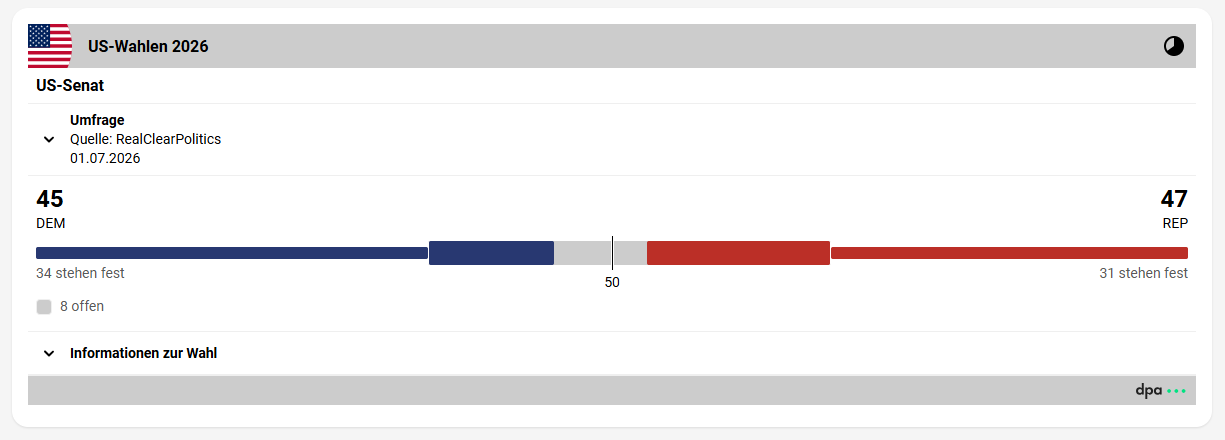
The figures above the bar - in the screenshot below, for example, 45 Democrats and 47 Republicans - show the total number of seats already confirmed in the future Senate. Since, for example, the Democrats have 45 seats secured and 34 of their Senate seats (from Class I and Class III) are not up for election in 2026, the party would have won 11 seats "at that moment." The basis for the number of seats won are the calls made by the Associated Press: once the AP declares a candidate the winner in a US state, that seat is added to the respective party's overall total.
The width of the bar reflects the proportional number of seats: the 34 Democratic seats not up for election in 2026 are represented by the thinner bar, while the 11 seats currently gained are shown by the thicker blue bar.
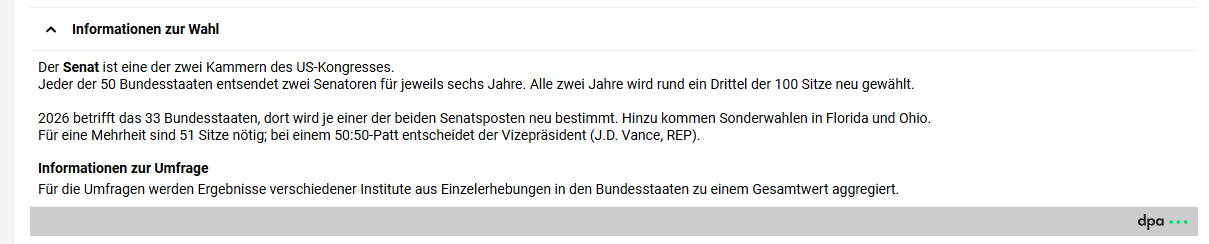
Clicking "Election information" opens an information panel on the Senate and polling:
Senate Module - Map (live results only)
This module shows a map of all US states. In the default view - before November 3 - the map is coloured entirely in two shades of grey, with states where no election is taking place in 2026 shown in light grey and not clickable.
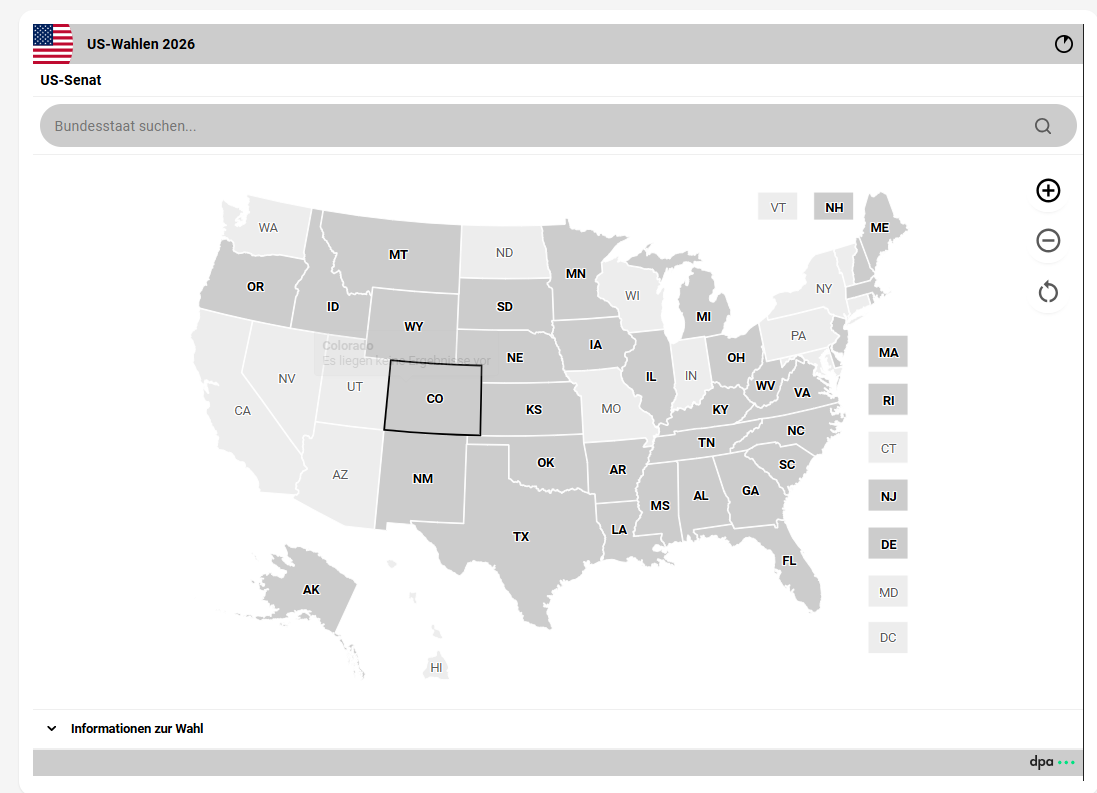
This module shows LIVE RESULTS ONLY - the map will only fill with colour once real results are available. For illustration purposes, below is an example using TEST DATA:
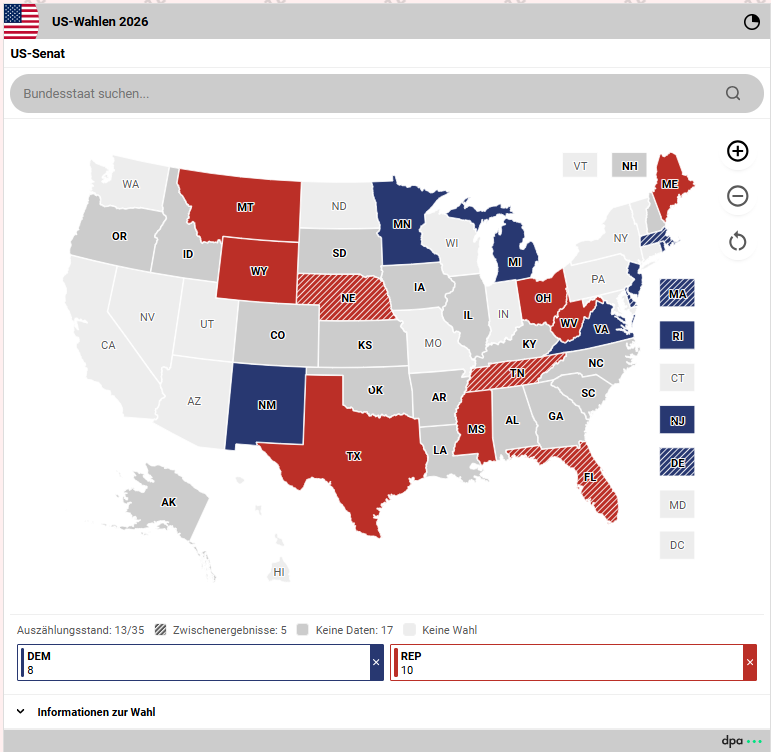
In this example, a winner has already been determined in 13 states (7 in red = Republican win, 6 in blue = Democratic win).
In the states shown with dashed borders, counting is still under way and the Associated Press has not yet called a winner. The colour of each such state indicates which party is leading according to the interim result.
States shown in darker grey have no data available yet.
The boxes below the legend add up, for each party, the states already won and projected wins.
Clicking these buttons allows users to show or hide on the map the states where each party has won seats or is currently leading.
Senate Module - Overall Result Bar and Map (live only)
This widget combines the visualizations of the two modules described above: the running Senate result in bar form at the top, with the US map showing individually clickable states below.
The widget will only go live with results from November 3 onwards.
Senate Module - Individual State
This widget offers the option of displaying results for a single state, selected in advance on the setup page via the dropdown menu. This is suited to coverage of, for example, particularly close races in individual states.
The widget will only go live with results from November 3 onwards.
House of Representatives Module - Overall Result Bar
This widget shows polls and results for the House of Representatives election. The future balance of power in the House is visualized solely through a bar chart - there is no map view.
Seats already allocated are shown in the respective party colour (blue/red), while seats still outstanding are shown in grey. The number of seats required for an absolute majority (218 seats), which is key to the future balance of power, is marked by a line in the centre of the bar.
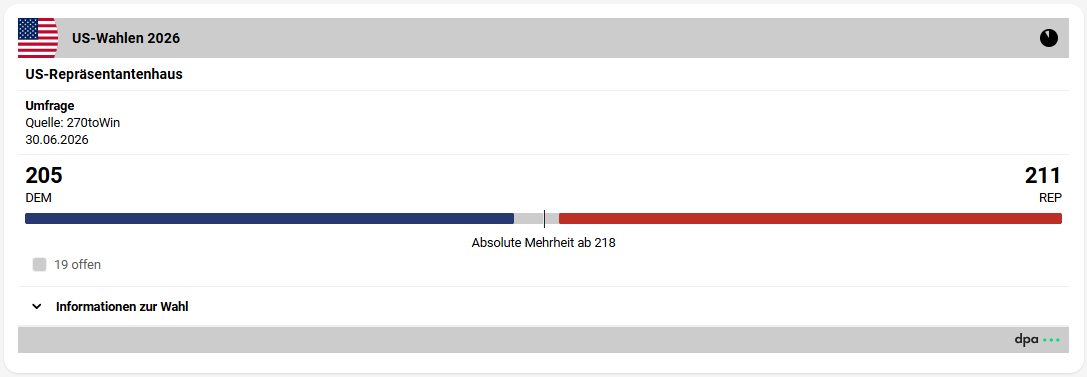
The House of Representatives has a total of 435 seats. In the example shown, the Democrats would win 205 seats according to the polls, the Republicans 211. In 19 states, the outcome appears unpredictable and therefore remains open (205 + 211 + 19 = 435).
On election day, November 3, the grey bar will represent the number of districts where counting has not yet been completed or where the Associated Press has not yet called a winner.
As an alternative to the display described above, the settings on the setup page can be used to specify that seats not yet counted are shown as dashed in the bar and included in the overall result:
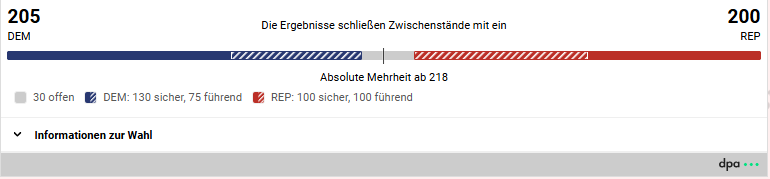
Clicking "Election information" opens an information panel on the House of Representatives and polling. The "Poll information" section will no longer be displayed once real election results begin to come in.

2026 Midterms (Senate): Republican and Democratic candidates
| State | Abbr. | REP Candidate | DEM Candidate | Notes |
|---|---|---|---|---|
| Alabama | AL | Barry Moore | Everett Wess | |
| Alaska | AK | Dan Sullivan * | Mary Peltola | additional candidates |
| Arkansas | AR | Tom Cotton * | Hallie Shoffner | additional candidate |
| Colorado | CO | Mark Baisley | John Hickenlooper * | |
| Delaware | DE | Michael Katz | Chris Coons * | additional candidates |
| Florida | FL | Ashley Moody * | Angela Nixon | special election |
| Georgia | GA | Mike Collins | Jon Ossoff * | additional candidates; absolute majority required, otherwise runoff |
| Idaho | ID | Jim Risch * | David Roth | additional candidates |
| Illinois | IL | Don Tracy | Juliana Stratton | additional candidates |
| Iowa | IA | Ashley Hinson | Josh Turek | special election; additional candidate |
| Kansas | KS | Roger Marshall * | Adam Hamilton | additional candidate |
| Kentucky | KY | Andy Barr | Charles Booker | additional candidates |
| Louisiana | LA | Julia Letlow | Jamie Davis | absolute majority required, otherwise runoff |
| Maine | ME | Susan Collins * | Graham Platner | |
| Massachusetts | MA | John Deaton | Ed Markey * | additional candidates |
| Michigan | MI | Mike Rogers | Abdul El-Sayed | additional candidates |
| Minnesota | MN | Michele Tafoya | Peggy Flanagan | additional candidates |
| Mississippi | MS | Cindy Hyde-Smith * | Scott Colom | |
| Montana | MT | Kurt Alme | Alani Bankhead | |
| Nebraska | NE | Pete Ricketts * | Cindy Burbank | |
| New Hampshire | NH | John Sununu | Chris Pappas | additional candidates |
| New Jersey | NJ | Justin Murphy | Cory Brooker * | |
| New Mexico | NM | Larry E. Marker | Ben Ray Luján * | |
| North Carolina | NC | Michael Whatley | Roy Cooper | |
| Ohio | OH | Jon Husted | Sherrod Brown | special election |
| Oklahoma | OK | Kevin Hern | N’kiyla Jasmine Thomas | additional candidates |
| Oregon | OR | David Brock Smith | Jeff Merkley * | |
| Rhode Island | RI | Raymond McKay | Jack Reed ** | additional candidates |
| South Carolina | SC | Darline Graham | Annie Andrews | REP candidate unexpectedly deceased; additional candidates |
| South Dakota | SD | Mike Rounds * | Julian Beaudion | additional candidate |
| Tennessee | TN | Bill Hagerty * | Marquita Bradshaw | additional candidates |
| Texas | TX | Ken Paxton | James Talarico | additional candidates |
| Virginia | VA | Bert Mizusawa | Mark Warner * | |
| West Virginia | WV | Shelley M. Capito * | Rachel F. Anderson | additional candidates |
| Wyoming | WY | Harriet Hageman | James Byrd |
* also incumbent
Parties
In some states only two candidates are on the ballot for the Senate election - one each from the Republican Party (GOP) and the Democratic Party (DEM). In other states, however, voters have a wider choice.
In addition to Republicans and Democrats, the following parties are running in at least one state in the US Senate elections:
- Alaskan Party: Alaska
- American Independent Party: Massachusetts
- Constitution Party: New Hampshire, West Virginia, South Carolina
- End the Corruption Party: New Jersey
- Green Party: Michigan, North Carolina
- Kentucky Party: Kentucky
- Legal Marijuana Now Party: Nebraska
- Libertarian Party: Arkansas, Idaho, Iowa, Kansas, Minnesota, Michigan, Montana, North Carolina, Ohio, Oklahoma, South Carolina, Texas
- Party for Socialism and Liberation: Massachusetts
- Socialist Workers Party: New Jersey
- Together for NJ Party: New Jersey
- U.S. Taxpayers Party: Michigan
- Independent candidates (IND) are also running in Delaware, Georgia, Idaho, Illinois, Kentucky, Massachusetts, Montana, New Jersey, New Mexico, North Carolina, Ohio, Oklahoma, Rhode Island, South Carolina, South Dakota, Tennessee, Texas, West Virginia
API
Information for customers of our Elections API
The election ID is us-2026
Technical documentation is available at: http://swagger.dpa-electionsdata.com/
Please ensure that your individual API begins as follows: https://digitalwires.dpa-newslab.com/…
Please remember to cache all data on your end after calling the API. This is important to avoid exceeding rate limits.
Please consider using different polling intervals for different endpoints. The [candidates], [polls] and [officeholders] endpoints will change little during election night. We recommend calling the [results] endpoint no more than once every 10 seconds.
Corner Cases:
Two Senate elections in one state
Under normal circumstances, only one of a state's two Senate seats is up for election in the midterms. In theory, both seats could require a new election - for example in the event of an unexpected resignation or the death of an incumbent.
Where two Senate elections take place simultaneously in one state, the second election is represented via an additional constituency.
Example: If two elections take place simultaneously in Texas, the first is represented as TX and the second as TX###2.
Note: TX###2 also serves as a test case and will be populated with test data in simulations.
Seat Types
The following seat types are represented:
Seats likely
Seats called by AP (won)Seats leans
Seats in which a candidate is leading (leading)Seats safe
Fixed seats not up for election (holdovers)Seats
Total of safe, called and leading seats (winning trend)
Overall result - result type
The overall result changes its result type from Trend to Preliminary once all seats have been allocated. In the House of Representatives, this is the case at 435 seats; in the Senate, at 100 seats in total.
Contact
If you have further questions, you can reach us Monday to Friday between 9:00 am and 5:00 pm via our service desk:
- by email at service@dpa-info.com
- by phone at 040 - 4113 31000
This document is updated regularly.